
Ever felt lost in life without a clear direction? The idea of a Lost Map speaks to many who search for their purpose. It’s a journey to find our true path and meaning.
The Purpose Map Podcast and articles dive into this concept. They offer insights on finding life’s direction. Understanding this journey helps us take the first steps forward.
Finding your purpose changes your life for the better. It’s about finding the right path and staying on it, even with challenges.
The Ancient Legend of Purpose Maps
The legend of Purpose Maps is ancient, shared across many cultures. The idea of a map has always been a symbol of guidance. It helps people navigate life’s complexities, not just physical places.
In different cultures, the “Map of Meaning” is key. It’s a guide for finding one’s purpose. This map is more than a tool; it’s a symbol of the journey to understand one’s place in the world.
Purpose Maps offer direction and clarity. They represent the search for meaning and purpose. They remind us that the journey is as important as reaching our goals.
Understanding What a “Lost Map” Really Means
In today’s fast world, the term “Lost Map” is a metaphor for searching for direction and purpose. It speaks to many who feel lost from their goals and dreams.
Purposelessness is a big issue, touching people from all backgrounds. The lack of direction can cause emptiness and unhappiness. It affects not just personal well-being but also society as a whole.
The Cost of Living Without Direction
Not having direction can lead to emotional distress and a sense of not being fulfilled. Without a clear purpose, making decisions and facing life’s challenges becomes hard.
Grasping the idea of a “Lost Map” is key to tackling purposelessness. By recognizing the issue, people can start looking for their path and live a more meaningful life.
Signs You’re Navigating Without a Map
Many people feel lost, not realizing they’re navigating without a map to their purpose.
This feeling can show up in many ways. You might feel unfulfilled or restless, without a clear life direction. Your daily tasks might seem dull, without any progress towards a meaningful goal.
Being lost in life without a clear map can make you feel stuck. You might not know how to move forward or make choices that match your purpose. Recognizing these signs is the first step to finding your way.
By admitting you’re navigating without a clear direction, you can start looking for your personal map. This map will outline your purpose and guide you towards a more fulfilling life.
The Components of Your Personal Purpose Map
To find your path to purpose, you need to know what makes up your personal purpose map. This map is like a guide that helps you make choices and stay on track with your goals.
One key part of your personal purpose map is your core values. Figuring out your core values is a key step in making a purpose map that fits your needs and goals. Brené Brown says, “When we are in the service of our values, we are in the service of something much bigger than ourselves.” This shows how important core values are in guiding our actions and choices.
Identifying Your Core Values
To find your core values, think about what’s most important to you in life. What are your non-negotiables? What makes you feel happy and fulfilled? Knowing your core values helps you make a purpose map that supports your personal growth.
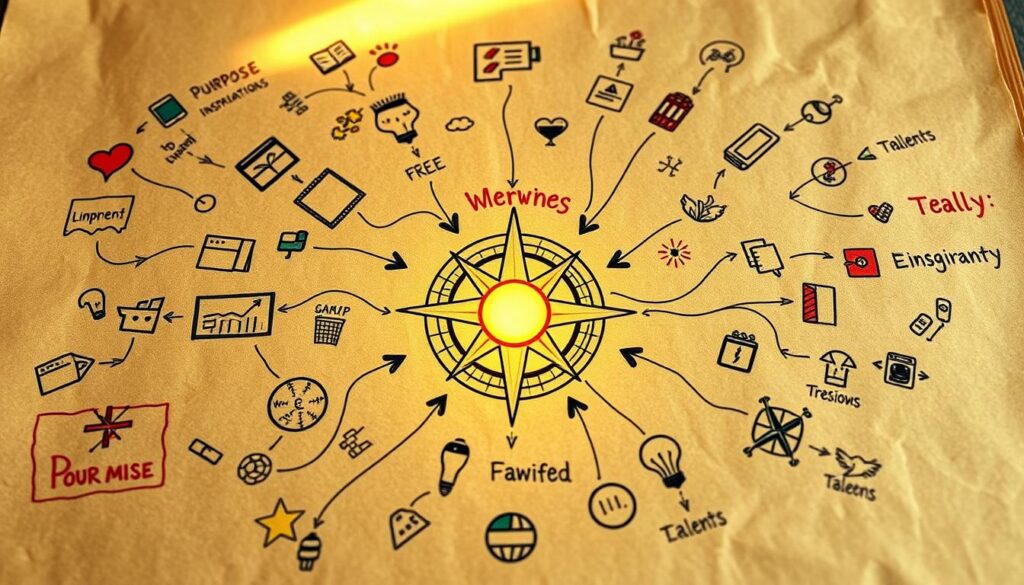
After finding your core values, use them to make choices that match your purpose map. When you have to make a decision, ask yourself, “Does this choice match my core values?” or “Will this choice help me grow?” This way, you make choices that support your purpose map and help you reach your goals.
Remember, your personal purpose map changes as you grow and learn. By regularly checking in with your core values, you keep your purpose map relevant and helpful for your growth.
“The purpose of life is not to be happy. It is to be useful, to be honorable, to be compassionate, to have it make some difference that you have lived and lived well.”
How to Uncover Your Lost Map of Purpose
Finding your lost map of purpose is a journey. It needs patience, self-reflection, and a willingness to explore. It’s about knowing what drives you and gives your life meaning.
One good way to start is through guided visualizations. These tools help you connect with your subconscious. They let you explore your desires, fears, and dreams safely.
Guided Visualizations for Finding Direction
Guided visualizations let you imagine yourself achieving your goals. They help you see your success and the steps to get there. This way, you can understand your purpose and the path ahead.
You can listen to guided meditations or do visualization exercises yourself. Use your imagination to picture your ideal future.
Mindfulness is key to finding your lost map of purpose. It helps you stay present and listen to your inner voice. This way, you can discover what truly matters to you.
Mindfulness, like meditation and deep breathing, increases awareness. It helps you make choices that match your values and dreams. This way, you can find your way back to your purpose.
By using guided visualizations and mindfulness together, you create a strong tool. This tool helps you discover and rediscover your purpose. It guides you through life’s challenges with more ease and direction.
The Landmarks of a Meaningful Life
As we journey through life, finding landmarks that show a meaningful existence is key. These landmarks are not just about places or times. They are personal signs that we’re moving towards our goals.
Defining Personal Landmarks means knowing what makes our life meaningful. According to
“The purpose is not a destination; it’s a journey, and it’s found in the everyday moments, the choices we make, and the values we uphold.”
For some, landmarks might be career wins. For others, it’s about strong personal bonds or helping the community.

To create these landmarks, we set goals that match our values and dreams. It’s about celebrating the small victories. They add up to a meaningful life. By aiming for these landmarks, we find our way and stay focused.
The landmarks of a meaningful life are special for each person. They’re shaped by our experiences, values, and dreams. By knowing and aiming for these landmarks, we can lead a more purposeful and happy life.
Navigating the Terrain of Uncertainty
Embracing uncertainty can lead to a more meaningful life. When we face uncertainty, it’s common to feel lost. We might not see a clear path ahead.
Understanding the Terrain
The world of uncertainty is complex and different for everyone. It lacks clear direction and makes us feel adrift.
To navigate this world, we need self-reflection, resilience, and sometimes help from others. We must be open to various paths and possibilities.
Practical Steps for Navigation
Start by setting small, achievable goals. This builds momentum and confidence. Mindfulness and staying present can also help reduce anxiety.
Direction Through Reflection
Regular self-reflection is key. It involves questioning our current state, desires, and goals. This helps us find a clearer direction, even when the path is not fully clear.
In conclusion, navigating uncertainty is a journey that needs patience, courage, and flexibility. By embracing these, we can find our direction and purpose.
Common Obstacles on Your Journey to Purpose
Finding your purpose is a personal and complex journey. Life can throw many obstacles your way, making it hard to move forward.
Social Media and Purpose Confusion
Social media can be a big obstacle. Sites like Instagram and Facebook show only the best parts of others’ lives. This can make you feel like you’re not good enough.
“The more time spent on social media, the more likely someone is to feel isolated.”
It’s important to know how social media affects you and keep your online life healthy.

Another challenge is following others instead of your own path. Steve Jobs said, “Your time is limited, so don’t waste it living someone else’s life.” Finding your unique strengths and passions is key to staying true to yourself.
By understanding these obstacles, you can prepare for your journey. Focus on your goals and keep your online presence positive. This will help you overcome these hurdles and stay on course.
Redrawing Your Map After Wrong Turns
Making wrong turns is a normal part of life. But how we react is what really matters. Nelson Mandela said, “The greatest glory in living lies not in never falling, but in rising every time we fall.” This shows us the importance of bouncing back and moving forward.
When we hit a roadblock, it’s time to take a step back and figure out what went wrong. Reflecting on our mistakes helps us see where we can do better. As we remake our map, we should also keep an eye out for new chances that might have come up.
“The best way to get back on track is to refocus on your destination.” Redrawing your map is more than just fixing mistakes. It’s about learning and growing from them. By seeing setbacks as chances for growth, we can turn them into stepping stones.
As we keep moving, staying flexible and updating our map is key. This might mean setting new goals or changing our path. This way, our map stays useful and guides us towards our goals.
“Success is not final, failure is not fatal: It is the courage to continue that counts.” –
Stories of Those Who Found Their Lost Map
Discovering one’s purpose can change a life, as seen in many stories. People have found their true calling after navigating through uncertainty. Their tales inspire others on their own journey.
One person felt stuck in a corporate job. They took a risk and followed their passion for photography. This move wasn’t just a career change; it was finding a new purpose in life.

Another story is about someone who felt lost for years. They found their way through volunteering. They realized their true calling was helping others, leading them to start a non-profit.
These stories show that finding your lost map is possible. It takes determination and the right mindset. They remind us it’s never too late to change and find our true purpose.
“The purpose of life is not to be happy. It is to be useful, to be honorable, to be compassionate, to have it make some difference that you have lived and lived well.”
These stories and quotes motivate people to keep searching for their lost map. They remind us that the journey is as important as the destination.
Creating a Daily Compass: Practical Tools for Staying on Course
Staying on track with your purpose is more than just having a map. It needs a daily compass to guide you through life’s ups and downs. A daily compass acts as a guide, helping you make choices that match your purpose.
Purpose Check-Ins
Regular purpose check-ins are key. Make time each day or week to think about your actions and goals. Ask if you’re getting closer to your purpose or if you need to change course.
Life is full of surprises, and your path might change. Use tools like journals or apps to track your journey and make changes. This keeps you moving towards your purpose.
Adding a daily compass to your daily routine helps you face challenges and keep your eyes on the prize. This way, you stay on the right path and live a fulfilling life.
The Continuous Journey: Your Map Will Always Evolve
As you find your way to purpose, remember your map changes. It grows with you, as you learn and face new challenges. This change is part of the journey, helping you adapt and refine your purpose.
Discovering your purpose is a never-ending journey. New experiences and insights will change your map. This shows your growth and new views. Embracing these changes helps you stay on track and move closer to your goals.
Being open to your map’s evolution lets you adapt to changes. This is important in today’s fast world. Remember, your map is a dynamic guide, leading you to a more purposeful life.